


Year in Review 2025
The Canadian Biomarker Integration Network in Depression (CAN-BIND) is a national program of research and learning. Our community includes persons with lived experience, caregivers, researchers, healthcare providers, government agencies, industry partners, and mental health advocates who are working together to achieve mental wellness for all Canadians.
2025 Highlights
As we step into the new year, we’re also taking a moment to celebrate some of our milestone moments from the past year. From research publications and podcast episodes to public engagement initiatives, the CAN-BIND team made significant strides in advancing mental health understanding and care. Explore the highlights below to see the achievements that defined our 2025 and continue to shape our future.


In Focus: Bringing Lived Experience to the Forefront
The CAN-BIND Community Advisory Committee (CAC) plays a vital role in guiding our research, ensuring it reflects the real needs and experiences of people living with mental health conditions and making our work more patient-centred and impactful. This past year, CAN-BIND launched a new initiative that enabled our community partners to attend international scientific conferences, connect directly with researchers, participate in scientific talks, and share their unique perspectives.
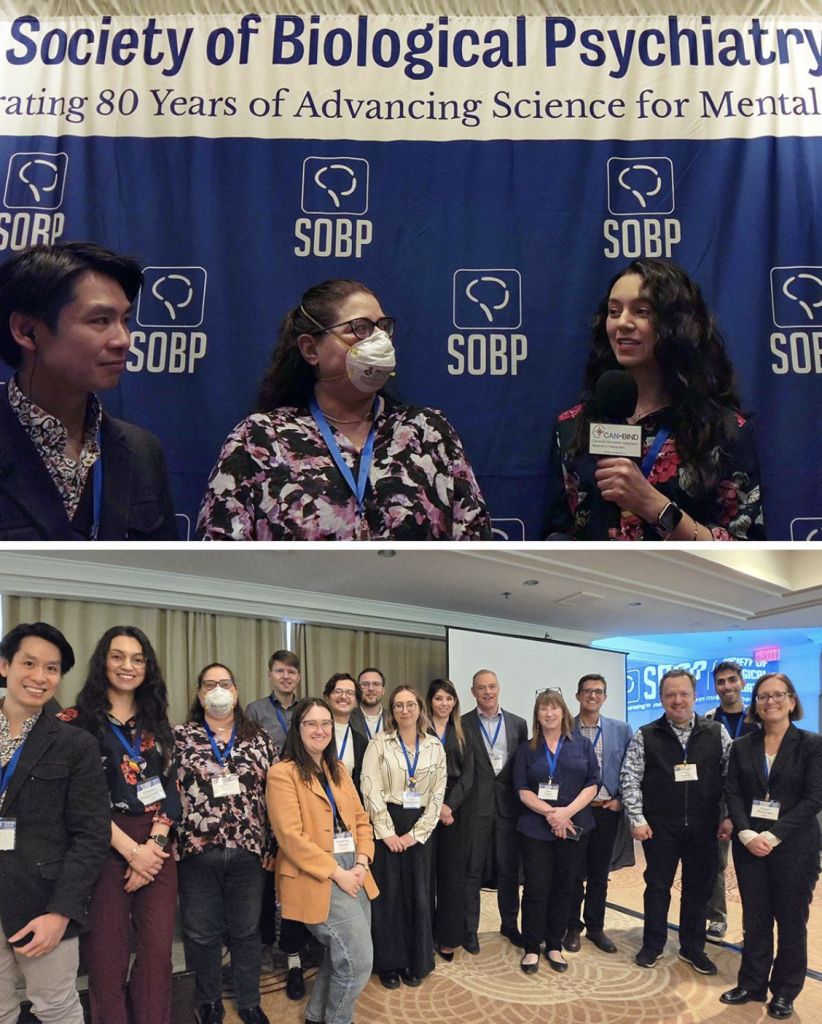
We spoke with two of our CAC members about their experiences at the 2025 Society of Biological Psychiatry (SOBP) conference in Toronto. Expand to read more!
For Geneviève and Christina, members of the CAN-BIND Community Advisory Committee (CAC), the Annual Meeting of the Society of Biological Psychiatry was more than just an academic gathering. It offered a firsthand look at how their involvement in mental health research connects to a global scientific community. Despite viewing dozens of posters and presentations, much of the research at the conference left a lasting impression.
For Christina, research on the gut–brain axis was especially striking. She was intrigued by the potential to predict treatment resistance or recovery based on gut health, which felt like a meaningful step toward more personalized and precise care. She was also deeply moved by work focused on youth self-harm prevention, particularly the development of digital tools designed to support young people in real time.
“It’s such a sensitive, often overlooked area… seeing real attention and innovation there gave me hope.”
Geneviève’s standout moment came from a study that used smartphones to monitor teen mental health. Researchers shared how they were able to infer changes in mood or well-being by tracking simple indicators, such as how often a phone was moved or used.
“The idea that you could monitor mental health indirectly through phone use was fascinating. Of course, there are privacy and ethical concerns, but within a medical or research context, it could be very powerful.”
For both CAC members, the value of attending in person was irreplaceable. Christina noted that the conference experience extended well beyond listening to presentations.
“You could walk up to a researcher, ask them questions, and actually have a conversation. It wasn’t one-sided. We were learning from them, and they were learning from us“.
Geneviève echoed the sentiment, recalling the informal conversations that unfolded between sessions and in hallways.
“Those moments made me feel part of the community. It wasn’t just observing from the sidelines.”
For both CAC members, the sense of mutual respect and inclusion was powerful, reinforcing why patient voices matter. The experience also highlighted the impact of bringing lived experience to the heart of mental health research. By connecting researchers with community members, we foster learning, dialogue, and collaboration that drive innovations both scientifically rigorous and genuinely meaningful for the people they are meant to help. Patient voices don’t just complement research, they shape it.
Geneviève summed it up simply:
“Being there made me realize how connected our work is to the broader picture. We’re not just participants; we’re contributors.”
For Christina, the takeaway was equally clear:
“When you include community members in research, you create something stronger, more relevant, and more human.”
Fresh Off The Press
CAN-BIND researchers contributed a wealth of publications advancing our understanding of mental health. From studies on early intervention and treatment strategies to innovations in technology and data-driven care, these publications have shared new knowledge, informed clinical practice, and helped shape the future of mental health research.
Generalizability of Treatment Outcome Prediction Across Antidepressant Treatment Trials in Depression
Researchers investigated whether models that predicted how someone with depression would respond to an antidepressant in one clinical trial could also make accurate predictions in other trials. Their work explored whether these predictions could be applied more broadly to guide treatment decisions and support more personalized care.


Predicting Relapse of Depressive Episodes During Maintenance Treatment: The Canadian Biomarker Integration Network in Depression (CAN-BIND) Wellness Monitoring in Major Depressive Disorder Study
A team of CAN-BIND researchers explored whether it was possible to predict relapse of depressive episodes in individuals receiving maintenance treatment. The study looked at how monitoring clinical, behavioural, and biological measures over time could help clinicians identify those at higher risk of relapse and provide care tailored to each individual’s unique needs.
Standardized EEG for Multi-Site Biomarker-Informed Trials: Implementation in the Canadian Biomarker Integration Network in Depression
CAN-BIND researchers developed a standardized method for using electroencephalography (EEG), which measures brain activity, across multiple sites for depression studies. Their work ensures that brain measurements are consistent and reliable, helping advance research that could improve diagnosis, monitor treatment response, and support more personalized care for people with depression.
Expand to browse our complete collection of publications from the past year!
- Lam, R. W., Rnic, K., Nunez, J.-J., Ho, K., LeMoult, J., Nunes, A., Chakrabarty, T., Foster, J. A., Frey, B. N., Harkness, K. L., Hassel, S., Kennedy, S. H., Li, Q. S., Milev, R. V., Quilty, L. C., Rotzinger, S., Soares, C. N., Taylor, V. H., Turecki, G., & Uher, R. (2025). Predicting Relapse of Depressive Episodes During Maintenance Treatment: The Canadian Biomarker Integration Network in Depression (CAN-BIND) Wellness Monitoring in Major Depressive Disorder Study: Prédire la rechute d’épisodes dépressifs pendant le traitement d’entretien : Une étude de suivi du bien-être dans les troubles dépressifs majeurs du Réseau canadien d’intégration des biomarqueurs pour la dépression (CAN-BIND). Canadian Journal of Psychiatry. Revue Canadienne de Psychiatrie, 07067437251337603. https://doi.org/10.1177/07067437251337603
- Magarbeh, L., Elsheikh, S. S. M., Islam, F., Marshe, V. S., Men, X., Tavakoli, E., Kronenbuerger, M., Kloiber, S., Frey, B. N., Milev, R., Soares, C. N., Parikh, S. V., Placenza, F., Hassel, S., Taylor, V. H., Leri, F., Blier, P., Uher, R., Farzan, F., … Müller, D. J. (2025). Polygenic Risk Score Analysis of Antidepressant Treatment Outcomes: A CAN-BIND-1 Study Report: Analyse des résultats du traitement antidépresseur à l’aide des scores de risque polygéniques : Rapport sur l’étude CAN-BIND-1. The Canadian Journal of Psychiatry, 07067437251329073. https://doi.org/10.1177/07067437251329073
- Nunes, A., Pavlova, B., Nuñez, J.-J., Quilty, L. C., Foster, J. A., Harkness, K. L., Ho, K., Lam, R. W., Li, Q. S., Milev, R., Rotzinger, S., Soares, C. N., Taylor, V. H., Turecki, G., Kennedy, S. H., Frey, B. N., Rudzicz, F., & Uher, R. (2025). Symptom network connectivity indices as predictors of relapse in major depressive disorder. Psychiatry Research, 350, 116562. https://doi.org/10.1016/j.psychres.2025.116562
- Rowe, J., Nogovitsyn, N., Mazurka, R., Squires, S. D., Hassel, S., Poppenk, J., Dunlop, K., Zamyadi, M., Milev, R. V., Foster, J. A., Arnott, S. R., Lam, R. W., Uher, R., Rotzinger, S., Kennedy, S. H., Frey, B. N., & Harkness, K. L. (2025). Latent profile analysis of childhood maltreatment and neural markers in depression. JAMA Network Open, 8(8), e2525147. https://doi.org/10.1001/jamanetworkopen.2025.25147
- Rueda, A., Demchenko, I., Tassone, V. K., Gholamali Nezhad, F., Peters, V., Churchill, N. W., Frey, B. N., Hassel, S., Lam, R. W., Milev, R. V., Müller, D. J., Schweizer, T. A., Strother, S. C., Taylor, V. H., Kennedy, S. H., Anteraper, S. A., & Bhat, V. (2025). Multi-voxel pattern analysis for characterizing functional connectivity and neurocognitive function in major depression: A CAN-BIND-1 report. NeuroImage: Clinical, 48, 103840. https://doi.org/10.1016/j.nicl.2025.103840
- Schwartzmann, B., Dhami, P., Chatterjee, R., Blier, P., Foster, J. A., Hassel, S., Ho, K., Lam, R. W., Milev, R., Müller, D. J., Parikh, S. V., Placenza, F., Quilty, L. C., Rosenblat, J., Soares, C. N., Taylor, V. H., Turecki, G., Rotzinger, S., Kennedy, S. H., … Farzan, F. (2025). Standardized EEG for multi-site biomarker-informed trials: Implementation in the Canadian Biomarker Integration Network in Depression. Clinical Neurophysiology, 178, 2110932. https://doi.org/10.1016/j.clinph.2025.2110932
- Stengel, C., Schwartzmann, B., Chatterjee, R., Atluri, S., Vaghei, Y., Arnott, S. R., Blier, P., Dhami, P., Foster, J. A., Frey, B. N., Lam, R. W., Milev, R., Müller, D. J., Parikh, S. V., Soares, C. N., Uher, R., Turecki, G., Rotzinger, S., Kennedy, S. H., & Farzan, F. (2025). Modulation of Brain Temporal Complexity During Treatment for Depression: A CAN-BIND-1 Study Report: Modulation de la complexité temporelle du cerveau pendant le traitement de la dépression: rapport de l’étude CAN-BIND-1. The Canadian Journal of Psychiatry, 07067437251408188. https://doi.org/10.1177/07067437251408188
- Uher, R., Rizvi, S. J., Quilty, L. C., Pavlova, B., Nunes, A., Foster, J. A., Lam, R. W., Milev, R., Müller, D. J., Taylor, V., Soares, C. N., Rotzinger, S., Kennedy, S. H., & Frey, B. N. (2026). Which aspects of anhedonia predict response to pharmacotherapy in major depressive disorder? Psychological Medicine, 56, e2. https://doi.org/10.1017/S0033291725102894
- Xiao, W., Woodham, R. D., Cui, Y., Wen, J., Antoniades, M., Srinivasan, D., Fan, Y., Erus, G., Garcia, J. A., Arnott, S. R., Chen, T., Choi, K. S., Chin Fatt, C., Frey, B. N., Frokjaer, V. G., Ganz, M., Godlewska, B. R., Hassel, S., Ho, K., … Fu, C. H. Y. (2025). Neuroanatomical dimensions in major depression linked to cognition, adverse life events, self-harm, metabolomics and genetics. Communications Medicine, 5(1), 502. https://doi.org/10.1038/s43856-025-01219-5
- Zhukovsky, P., Trivedi, M. H., Weissman, M., Parsey, R., Kennedy, S., & Pizzagalli, D. A. (2025). Generalizability of treatment outcome prediction across antidepressant treatment trials in depression. JAMA Network Open, 8(3), e251310. https://doi.org/10.1001/jamanetworkopen.2025.1310
The CAN-BIND Podcast
The CAN-BIND Podcast brought listeners into thought-provoking conversations that shined a light on mental health in new ways. From uncovering the surprising link between diet and well-being to exploring suicide prevention and examining the role of artificial intelligence in shaping the future of care, each episode offered both expert perspectives and valuable insights.
Food for Thought: The Surprising Link Between Diet and Mental Health
Food and mood—two things we often separate in our minds. But what if they’re more connected than we think?
Dr. Nirushi Kuhathasan explores the work of clinician-scientist and psychiatrist Dr. Fabiano Gomes from McMaster University. The episode examines the connection between food and mental health, including the effects of processed foods and the gut–brain connection, and highlights how nutrition influences brain function and may play a role in mental health treatment.
Released: February 03, 2025
Artificial Intelligence and Mental Health: The Future of Care? [Part 1]
Artificial intelligence (AI) is emerging as a transformative force in healthcare, with increasing relevance for mental health research and clinical practice.
In part one of this two-part episode, host Dr. Sagar Parikh is joined by Dr. Frank Rudzicz, Associate Professor in the Faculty of Computer Science at Dalhousie University. The episode explores the foundations of AI, how it differs from everyday tools, and how it is already being used in research and clinical settings, offering insight into what AI could mean for the future of mental health care.
Released: May 22, 2025
Breaking the Stigma: Understanding Suicide Risk and Prevention
Suicide impacts more than just the individual. It ripples through families, friends, and communities.
Our host, Andrew Kcomt, is joined by Dr. Sakina Rizvi, Chair of the ASR Suicide & Depression Studies Program at St. Michael’s Hospital, to discuss the complexities of suicide risk and prevention. The episode also explores neurobiological, psychological, and social factors, as well as strategies for identifying and supporting those at risk.
Released: March 24, 2025
Artificial Intelligence and Mental Health: The Future of Care? [Part 2]
The rise of artificial intelligence is redefining healthcare, shaping both how mental health is studied and how care is delivered.
In part two of this episode, host Dr. Sagar Parikh returns with Dr. Frank Rudzicz to explore how AI is applied within the CAN-BIND program, its impact on research and clinical decision-making, and the ethical considerations of integrating AI into mental health care, while reflecting on how to balance innovation with responsible use.
Released: August 7, 2025
Stay connected! Follow us on social media for our latest updates.